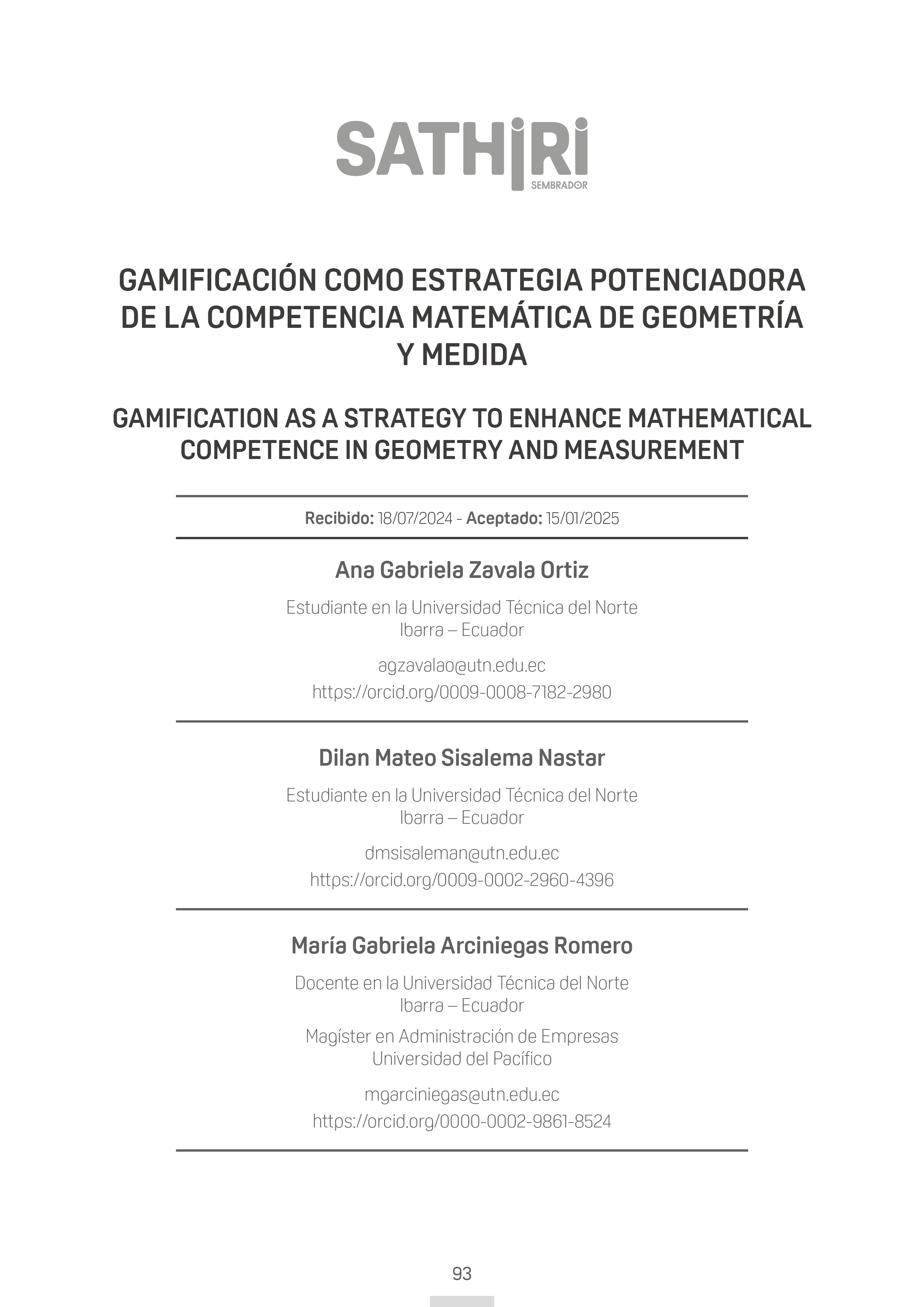
Gamification as a strategy to enhance mathematical competence in geometry and measurement
DOI:
https://doi.org/10.32645/13906925.1332Keywords:
Gamification, Geometry, Mathematics educationAbstract
Geometry and measurement are fundamental areas of focus within the mathematics curriculum in Ecuador that promotes the development of essential cognitive skills in students. The objective of this study was to determine the incidence of the methodological strategy of gamification in the development of the mathematical competence geometry and measurement. The research was quantitative with a descriptive relational scope and quasi-experimental design, involving 144 high school students from 6 public schools in the city of Ibarra. An initial pretest analysis showed that 55% of the students had a low level of geometric competencies, while the remaining 45% had a medium or high level. These data were contrasted with those obtained in a post-test, revealing a decrease in the number of students with low level to 44%, compared to the increase of students with medium and high level to 56%. Although the initial results revealed that students were developing the assessed competency, more than half of them did not reach the expected level, indicating the need for innovative strategies to improve learning. The findings demonstrate the potential of gamification to transform geometry and measurement instruction in Ecuador. If properly adapted to the school context, this strategy could be a key tool in overcoming challenges students face in developing these skills
Downloads
References
Bai, S., Hew, K. F., & Huang, B. (2020). Does gamification improve student learning outcome? evidence from a meta-analysis and synthesis of qualitative data in educational contexts. Educational Research Review, 30. https://doi.org/10.1016/j.edurev.2020.100322
Barrera Gutiérrez, M. I., & Tigse Caiza, J. A. (2022). La gamificación en el aprendizaje cooperativo de los niños de 4 a 5 años [Tesis de Grado, Universidad Técnica de Ambato]. https://repositorio.uta.edu.ec/jspui/handle/123456789/35025
Córdova, P. (2022). La gamificación como estrategia didáctica para la enseñanza y aprendizaje en la competencia numérica en el área de matemática. [Tesis de Postgrado, Universidad Técnica del Norte]. Obtenido de http://repositorio.utn.edu.ec/handle/123456789/13355
Cruz, C. (2023). La gamificación como estrategia didáctica e innovadora para la enseñanza de la matemática en sexto año de básica de la Unidad Educativa "Ibarra". [Tesis de Postgrado, Universidad Técnica del Norte]. Obtenido de http://repositorio.utn.edu.ec/handle/123456789/15331
Cupuerán, E. (2023). La gamificación como estrategia didáctica innovadora para la enseñanza de las matemáticas en básica superior. [Tesis de Postgrado, Universidad Técnica del Norte]. Obtenido de http://repositorio.utn.edu.ec/handle/123456789/14545
Cura Baniandres, Ó. (2021). El aprendizaje de los conceptos geométricos en educación primaria. Figuras planas [ Universidad de Valladolid. Facultad de Educación de Segovia]. https://uvadoc.uva.es/handle/10324/47946
Galitskaya, V., y Antoniou, Α. (2024). Geometría: una habilidad innata que, sin embargo, dificulta el aprendizaje de los estudiantes de todo el mundo. Revista mundial de tecnología y ciencias de ingeniería avanzadas. https://doi.org/10.30574/wjaets.2024.13.1.0483.
Galván-Cardoso, A., & Siado-Ramos, E. (2021). Educación Tradicional: Un modelo de enseñanza centrado en el estudiante. Revista Interdisciplinaria de Humanidades, Educación, Ciencia y Tecnología, 7(12), 962–975. https://dialnet.unirioja.es/servlet/articulo?codigo=7915387
Gamboa Caicedo, G., Porras Álvarez, J., & Campos, M. (2020). Gamificación y creatividad como fundamentos para un aprendizaje significativo. Revista EDUCARE - UPEL-IPB-Segunda Nueva Etapa 2.0, 24(3), 473–487. https://doi.org/10.46498/reduipb.v24i3.1316
García, J., García, B., González D., Jiménez, A., Jiménez, Eva., & González, M. (2013). EVAMAT Prueba para la Evaluación de la Competencia Matemática. Instituto de Orientación Psicológica EOS, 1. https://spotpsicopedagogico.wordpress.com/wp-content/uploads/2013/10/manual-evamat-vol-1.pdf
Gómez, P. (2022). La gamificación como herramienta de aprendizaje en educación infantil [Tesis de Grado Universidad de Sevilla]. https://idus.us.es/items/aeb940f1-3e39-450f-8466-55d396206054
Guerrero, G. (2021). Gamificación como estrategia aplicada al desarrollo de competencias digitales docentes en la Unidad Educativa Católica "La Victoria". [Tesis de Postgrado, Universidad Técnica del Norte]. Obtenido de http://repositorio.utn.edu.ec/handle/123456789/10930
Institución Nacional de Evaluación Educativa. (2023). Informe Nacional Ser Estudiante-Nivel de Bachillerato. INEVAL. https://cloud.evaluacion.gob.ec/dagireportes/sestciclo21/nacional/2022-2023_3.pdf
Institución Nacional de Evaluación Educativa (2024). Políticas transformadoras: hacia el nuevo Ecuador, desde la evaluación educativa. INEVAL. https://evaluaciones.evaluacion.gob.ec/BI/politicas-transformadoras-hacia-el-nuevo-ecuador-desde-la-evaluacion-educativa/
Jones, K. (2000a). Critical issues in the design of the geometry curriculum. In readings in mathematics education (pp. 75–90). https://core.ac.uk/download/pdf/32759.pdf
Jones, K. (2000b). Teacher knowledge and professional development in geometry. In Proceedings of the British Society for Research into Learning Mathematics, 3, 109–114. https://eprints.soton.ac.uk/41293/1/Jones_BSRLM_20_3_2000.pdf
Juleha, S., Sudirman, S., Nurafifah, L., Arifuddin, A., & Gunadi, F. (2021). Investigating the Cognitive Development of Slow Learners through Constructivist Geometry Games. Proceedings of the First International Conference on Economics, Business and Social Humanities. https://doi.org/10.4108/EAI.4-11-2020.2304653,
Ministerio de Educación. (2016). Currículo de EGB y BGU - Matemáticas. Mineduc. https://educacion.gob.ec/wp-content/uploads/downloads/2016/03/MATE_COMPLETO.pdf
Muftirah, A., Putra, J., Nurhalisa, & Irmayanti. (2023). Madrasah Students’ Difficulties in Geometry Material. COMPETITIVE: Journal of Education, 2(4), 294–301. https://doi.org/10.58355/competitive.v2i4.51
Navarro Mateos, C., Pérez López, I. J., & Marzo, P. F. (2021). La gamificación en el ámbito educativo español: revisión sistemática (Gamification in the Spanish educational field: a systematic review). Retos, 42, 507–516. https://doi.org/10.47197/retos.v42i0.87384
Ordóñez, M. (2022). La gamificación como estrategia didáctica en el aprendizaje - enseñanza de operaciones aritméticas con números racionales en séptimo de básica de la escuela Juan José Flores [Tesis de Maestría. Universidad Politécnica Salesiana].
Ortiz-Colón, A. M., Jordán, J., & Agredai, M. (2018). Gamification in education: An overview on the state of the art. Educacao e Pesquisa, 44. https://doi.org/10.1590/S1678-4634201844173773
Ortiz-Mendoza, G. J., & Guevara-Vizcaíno, C. F. (2021). Gamificación en la enseñanza de Matemáticas. EPISTEME KOINONIA, 4(8), 164. https://doi.org/10.35381/e.k.v4i8.1351
Quiroz Peña, J. I., Rizo Vélez, J. R., De La Torre Lascano, C. M., & Rizo Vélez, G. D. (2022). Impacto de la gamificación en el aprendizaje de estudiantes universitarios ecuatorianos. Estudio de caso. Revista Estudios Del Desarrollo Social: Cuba y América Latina, 10. https://revistas.uh.cu/revflacso/article/view/10
Pumacallahui, E., Acuña, C., & Calcina, D. (2021). Influencia del software GeoGebra en el aprendizaje de la geometría en estudiantes de cuarto grado de secundaria en el distrito de Tambopata de la región de Madre de Dios. Educación matemática, 33(2), 245-273.https://doi.org/10.24844/em3302.10
Robitaille, D., & Travers, K. (1986). Estudios en educación matemática. La Geometría en las escuelas. UNESCO,5, 19–30. https://unesdoc.unesco.org/ark:/48223/pf0000124809_spa
Ruiz, Á. (2003). Historia y filosofía de las matemáticas. Editorial Universidad Estatal a Distancia.https://books.google.com.ec/books?id=Q7gc9S63WDYC&pg=PA1&hl=es&source=gbs_toc_r&cad=2#v=onepage&q&f=false
Ulloa Arias, D. F., & Carcausto Calla, W. (2024). Efecto de la gamificación en el aprendizaje activo: Revisión sistemática. Horizontes. Revista de Investigación En Ciencias de La Educación, 8(33), 931–944. https://doi.org/10.33996/revistahorizontes.v8i33.774
Vargas, R. (2024). Aprendizaje basado en proyectos y competencias matemáticas en estudiantes de una institución de educación superior privada de Lima, 2023 [Tesis de maestría]. Universidad César Vallejo.
Vasquez, N. (2021). Estado del arte sobre la gamificación como elemento motivador en educación primaria. Universidad Peruana Cayetano Heredia. https://hdl.handle.net/20.500.12866/13938
Zapata-Velez, V., López-Odar, G. A., Pintado-Sandoval, L. A., Calle-Zurita, L. E., & Bizueta-Lozada, S. A. (2021). Juegos didácticos y desarrollo de competencias matemáticas en estudiantes de educación primaria. Prohominum, 3(Extraordinario 1), 266–287. https://doi.org/10.47606/acven/ph0056
Downloads
Published
Issue
Section
License
Copyright (c) 2025 Ana Gabriela Zavala Ortiz, Dilan Mateo Sisalema Nastar, María Gabriela Arciniegas Romero, Selina Dejaneyra Guiz Aza, Adrián Alexander Pilataxi Yacelga

This work is licensed under a Creative Commons Attribution-NonCommercial-NoDerivatives 4.0 International License.
El autor mantiene los derechos morales e intelectuales de su obra, autorizando a la editorial de la revista Sathiri la difusión y divulgación de su contenido con fines estrictamente académicos y de investigación, sin fines de lucro. Así mismo, se autoriza que la obra sea descargada y compartida con otras personas, siempre y cuando no sea alterada y se reconozca su autoria.