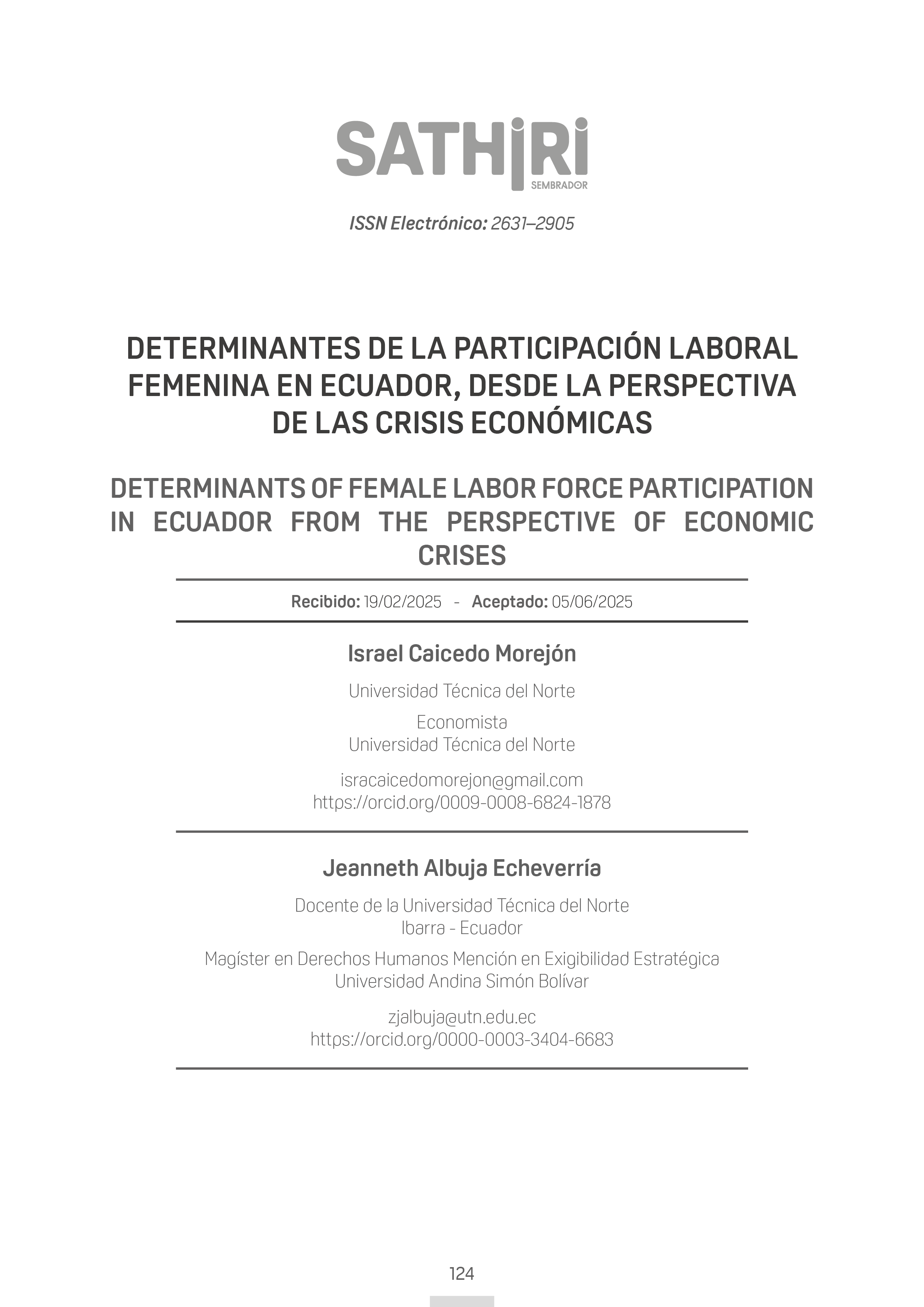
Determinants of female labor force participation in Eecuador from the perspective of economic crises
DOI:
https://doi.org/10.32645/13906925.1398Keywords:
Female labor participation, economic crises, structural vulnerability, inclusive and resilient economyAbstract
Female labor force participation in the context of economic crises is a critical issue in Ecuador. The impact of the 2000 dollarization, the 2008 financial crisis (the Great Recession), and the COVID-19 pandemic on female labor participation has been analyzed. The research question focuses on how economic crises have affected women’s ability to integrate and remain in the labor force, considering factors such as fertility, education, and unemployment. A panel data econometric model is employed to examine variables like fertility rate, unemployment, and secondary school enrollment between 1990 and 2022. The results indicate that dollarization had the most significant negative impact, followed by the pandemic, while the 2008 crisis was less substantial. The fertility rate showed that a one percentage point increase led to a 2.24% decrease in female labor participation, limiting women’s employment opportunities. On the other hand, female unemployment indicated that a one percentage point increase reduced female labor participation by 0.14%. However, in Ecuador, secondary school enrollment rates were not significant in relation to female labor participation. It is concluded that policies need to be implemented to remove structural barriers and improve women’s economic resilience during times of crisis.
Downloads
References
Acosta, A., & Serrano, A. (2009). Ecuador frente a la crisis económica internacional: un reto de múltiples aristas. https://revistas.usfq.edu.ec/index.php/polemika/article/view/306
Albuja, J. (2022). Universidad Andina Simón Bolívar instrumento de exigibilidad estratégica de derechos humanos. https://repositorio.uasb.edu.ec/handle/10644/8534
Albuja, W., & Enríquez, M. J. (2018). Análisis de la discriminación laboral hacia las mujeres en Ecuador 2007-2016. Convergencia, 25(78), 13–41. https://doi.org/10.29101/CRCS.V0I78.9692
Ángeles, M., Domínguez, S., & García Quero, F. (2011). Crisis económicas y cambio institucional en España: de la Gran Depresión a la crisis de 2008. https://digibug.ugr.es/handle/10481/29184
Banco Central del Ecuador. (2010a). Datos de pobreza BCE. https://contenido.bce.fin.ec/documentos/Estadisticas/SectorReal/Previsiones/IndCoyuntura/Empleo/PobrezaDic2010.pdf
Banco Central del Ecuador. (2010b). Dolarización BCE. https://contenido.bce.fin.ec/documentos/PublicacionesNotas/Notas/Dolarizacion/Dolarizacion10anios.pdf
Banco Mundial. (2022). Desempleo, mujeres (% de la población activa femenina) (estimación OIT) - Ecuador | Data. https://datos.bancomundial.org/indicator/SL.UEM.TOTL.FE.ZS?locations=EC
Banco Mundial. (2023). Inflación, precios al consumidor (% anual) - Ecuador | Data. https://datos.bancomundial.org/indicator/FP.CPI.TOTL.ZG?locations=EC
Baquero, M., Freire, B., & Jimbo, G. (2004). Evolución de mercados laborales formales e informales en Ecuador. https://contenido.bce.fin.ec/documentos/PublicacionesNotas/Catalogo/Apuntes/ae46.pdf
Becker, G. S. (1994). Human Capital: A Theoretical and Empirical Analysis with Special Reference to Education, Third Edition. Human Capital: A Theoretical and Empirical Analysis with Special Reference to Education. https://www.nber.org/books-and-chapters/human-capital-theoretical-and-empirical-analysis-special-reference-education-third-edition
CEPAL. (2022). Iliana Vaca Trigo División de Asuntos de Género. https://repositorio.cepal.org/server/api/core/bitstreams/edc6e8c4-d873-4ad7-a069-1a4a260ca8c1/content
CEPAL. (2019). Estudio Económico de América Latina y el Caribe 2019. El nuevo contexto financiero mundial: efectos y mecanismos de transmisión en la región | Comisión Económica para América Latina y el Caribe. https://www.cepal.org/es/publicaciones/44674-estudio-economico-america-latina-caribe-2019-nuevo-contexto-financiero-mundial
Ehsan, S. (2015). Female Labor Force Participation, Its Determinants and Effect on GDP in Pakistan. https://www.researchgate.net/publication/339310409_The_effect_of_an_increase_in_female_labor_force_participation_on_GDP_in_Pakistan
Espino, A., Amarante, V., Azar, P., Machado, A., Salvador, S., & Tenenbaum, V. (2019). Las desigualdades de género y la ciencia económica. La perspectiva de la economía feminista. https://www.cse.udelar.edu.uy/wp-content/uploads/2021/07/Desigualdades-Final.pdf
García, J., & Cortez, P. (2011). Analysis of women’s labor force participation in the Ecuadorian market. https://www.ecuadorencifras.gob.ec/documentos/web-inec/Revistas/Analitika/volum-multimedia/ANAlitica4/files/assets/downloads/page0029.pdf
Goldin, C. (1990). Understanding the Gender Gap: An Economic History of American Women. Oxford University Press. https://www.nber.org/books-and-chapters/understanding-gender-gap-economic-history-american-women
Hendry, D. F., & Johansen, S. (2015). Model Discovery and Trygve Haavelmo’S Legacy. Econometric Theory, 31(1), 93–114. https://doi.org/10.1017/S0266466614000218
Heylen, F., Schollaert, A., Everaert, G., & Pozzi, L. (2003). FACULTEIT ECONOMIE EN BEDRIJFSKUNDE HOVENIERSBERG 24 B-9000 GENT Inflation and human capital formation: theory and panel data evidence. https://citeseerx.ist.psu.edu/document?repid=rep1&type=pdf&doi=cb7621c7668fec909a92723cf87e6944121f2c7e
Instituto Nacional de Estadística y Censos: home (2020). Datos trabajo no remunerado. https://www.ecuadorencifras.gob.ec/documentos/web-inec/Estadisticas_Economicas/Cuentas_Satelite/Cuenca_satelite_trab_no_remun_2017/2_Presentacion_resultados_CSTNRH.pdf
Organización para la Cooperación y el Desarrollo Económico (2020). Impacto social del COVID-19 en Ecuador desafíos y respuestas. http://esacc.corteconstitucional.gob.ec/storage/api/v1/10_DWL_FL/e2NhcnBldGE6J2VzY3JpdG8nLCB1dWlkOic0Y2ZmMWFkZi1mYjI3LTQyZjQtYjY5Ni1lYWM1MTUyYjBjOTcucGRmJ30=
Organización Internacional del Trabajo (2022). Análisis de la afectación de la pandemia de la COVID-19 en el riesgo de informalidad laboral y pobreza de Ecuador | Naciones Unidas en Ecuador. https://ecuador.un.org/es/244026-análisis-de-la-afectación-de-la-pandemia-de-la-covid-19-en-el-riesgo-de-informalidad-laboral
Organización de las Naciones Unidas Mujeres (2024). ONU Mujeres | Explicativo: Los efectos del COVID-19 sobre las mujeres y las niñas. https://interactive.unwomen.org/multimedia/explainer/covid19/es/index.html
Organización de las Naciones Unidas para la Educación, la Ciencia y la Cultura. (2020). Informe de seguimiento de la educación en el mundo, 2020: Inclusión y educación: todos y todas sin excepción - UNESCO Biblioteca Digital. Unesco, 1–458. https://unesdoc.unesco.org/ark:/48223/pf0000374817Pérez, B. (2019). Scholarship @ Claremont The Role of Quality Education in the Economic Development of Mexico. https://scholarship.claremont.edu/cmc_theses/2204
Portillo, F. (2006). Introducción a la econometría. https://www.unirioja.es/cu/faporti/ieTEMA01.pdf
Ramírez, J., & Campuzano, J. (2021). Análisis del crecimiento del desempleo en el Ecuador: período 2010-2021. Religación. Revista de Ciencias Sociales y Humanidades, 6(30), e210850. https://doi.org/10.46652/rgn.v6i30.850
Downloads
Published
Issue
Section
License
Copyright (c) 2025 Israel Caicedo Morejón , Jeanneth Albuja Echeverría , Wilma Matilde Guerrero Villegas

This work is licensed under a Creative Commons Attribution-NonCommercial-NoDerivatives 4.0 International License.
El autor mantiene los derechos morales e intelectuales de su obra, autorizando a la editorial de la revista Sathiri la difusión y divulgación de su contenido con fines estrictamente académicos y de investigación, sin fines de lucro. Así mismo, se autoriza que la obra sea descargada y compartida con otras personas, siempre y cuando no sea alterada y se reconozca su autoria.
How to Cite