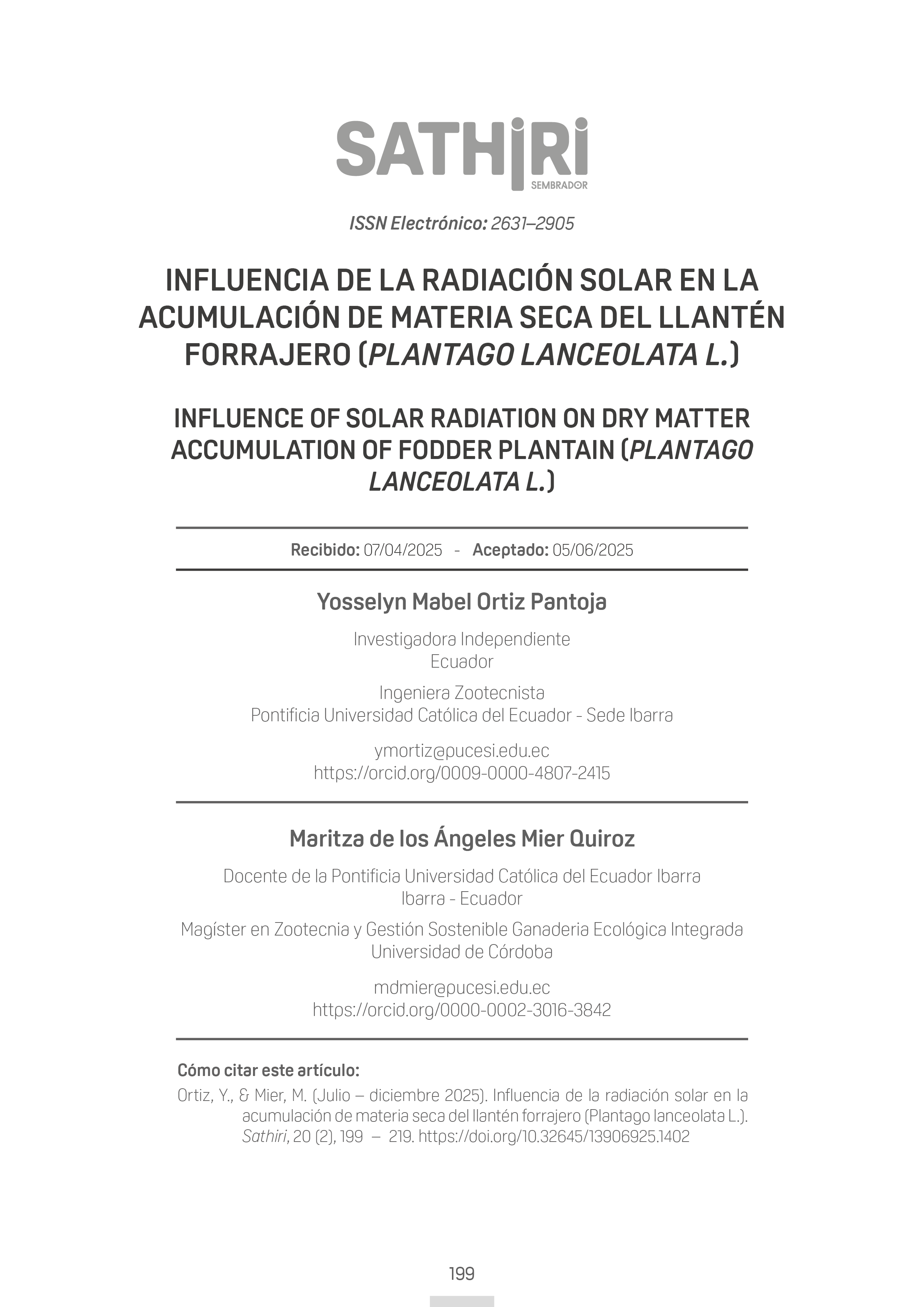
Influence of solar radiation on dry matter accumulation of fodder plantain (Plantago Lanceolata L.)
DOI:
https://doi.org/10.32645/13906925.1402Keywords:
climate change, sustainability, forage production, biomassAbstract
Solar radiation directly influences the accumulation of dry matter, but it is also crucial to determine the optimum moment to take advantage of the nutritional content of pastures. In the case of fodder plantain (Plantago lanceolata L.), it is recommended to use it when it reaches 6 to 7 true leaves, establishing between 7 to 10 days, as opposed to white clover, which does so in 10 to 12 days. It is important to consider that mature plants tend to accumulate anti-nutritional compounds, such as tannins, which reduce their palatability and digestibility, in addition to contributing to greenhouse gas emissions. Climate change also reduces growing seasons, affecting pasture quality. This research aims to evaluate, through a documentary analysis, the accumulation of dry matter, protein and energy in forage plantain, considering climatic variables such as solar radiation, relative humidity and precipitation. The objective of this research is to evaluate, through a documentary analysis, the accumulation of dry matter, protein and energy in fodder plantain, considering climatic variables such as solar radiation, relative humidity and precipitation. A methodology based on literature review of scientific articles published between 2015 and 2025, from databases such as Scopus, ScienceDirect and Web of Science was used, focusing the search on producing countries. The results showed that Colombia presented the most balanced data (3750 kg/ha DM, 153.62 kWh/m² of radiation, 77 % relative humidity and 3240 mm of precipitation), concluding that fodder plantain is a resilient and efficient species in diverse climatic conditions, with a higher productive potential in areas with radiation of 150-200 kWh/m² and precipitation between 1000 and 3000 mm, conditions similar to those of Ecuador.
Downloads
References
Abate, L., Bachheti, R. K., Tadesse, M. G., & Bachheti, A. (2022). Ethnobotanical Uses, Chemical Constituents, and Application of Plantago lanceolata L. Journal of Chemistry, 2022, 1–17. https://doi.org/10.1155/2022/1532031
Alves, J., Ribeiro, A., Paiva, Y., Araujo, R., & Brown, S. (2021). Carbon uptake and water vapor exchange in a pasture site in the Brazilian Cerrado. Journal of Hydrology, 594, 125943. https://doi.org/10.1016/j.jhydrol.2020.125943
Baeza, S., Paruelo, J., & Ayala, W. (2011). Eficiencia en el uso de la radiación y productividad primaria en recursos forrajeros del este de Uruguay. 15.
Bahadori, M. B., Sarikurkcu, C., Kocak, M. S., Calapoglu, M., Uren, M. C., & Ceylan, O. (2020). Plantago lanceolata as a source of health-beneficial phytochemicals: Phenolics profile and antioxidant capacity. Food Bioscience, 34. https://doi.org/10.1016/j.fbio.2020.100536
Barrios, E., & Ayala, W. (2015). Utilización de Plantago lanceolata en la alimentación de corderos en el período estival.
Bautista, I. (2016). Cálculo de la radiación solar extraterrestre en función de la latitud y la declinación solar.
Benguit, A., Tiwari, B., Drogui, P., & Landry, D. (2022). Tertiary treatment of a mixture of composting and landfill leachates using electrochemical processes. Chemosphere, 292. https://doi.org/10.1016/j.chemosphere.2021.133379
Bhattarai, K., Bushman, S., Johnson, D., & Carman, J. (2010). Phenotypic and Genetic Characterization of Western Prairie Clover Collections From the Western United States. Rangeland Ecology & Management, 63(6), 696–706. https://doi.org/10.2111/REM-D-10-00008.1
Bilotto, F., Harrison, M., Vibart, R., Mackay, A., Christie, K., Ferreira, C., Cottrell, R., Forster, D., & Chang, J. (2024). Towards resilient, inclusive, sustainable livestock farming systems. In Trends in Food Science and Technology (152). Elsevier Ltd. https://doi.org/10.1016/j.tifs.2024.104668
Bonifaz, N., León, R., & Gutiérrez, F. (2018). Pastos y forrajes del Ecuador Siembra y producción de pasturas Pastos y forrajes del Ecuador.
Cifuentes, L., Moreno Hurtado, F., Diego León-Peláez, J., & Paz, H. (2020). Drought resistance traits predict tree species performance in a humid tropical landscape, but their importance shifts between managed cover types. Forest Ecology and Management, 468. https://doi.org/10.1016/j.foreco.2020.118160
Coblentz, W. K., Akins, M. S., Kalscheur, K. F., Brink, G. E., & Cavadini, J. S. (2018). Effects of growth stage and growing degree day accumulations on triticale forages: 1. Dry matter yield, nutritive value, and in vitro dry matter disappearance. Journal of Dairy Science, 101(10), 8965–8985. https://doi.org/10.3168/jds.2018-14868
Cuadra, P., Niculcar, R., & Fajardo, V. (2023). Efectos de la radiación UV-B sobre la morfología, los compuestos absorbentes de UV-B y el contenido de pigmentos fotosintéticos de Plantago lanceolata yRheum rhabarbarum. Botánica Gayana, 80, 38–48.
DairyNZ. (2023). Llantén: Manejo del pastoreo lechero.
De la Rosa, M., Sandoval, E., Luo, D., Pacheco, D., & Jonker, A. (2022). Effect of feeding fresh forage plantain (Plantago lanceolata) or ryegrass-based pasture on methane emissions, total-tract digestibility, and rumen fermentation of nonlactating dairy cows. Journal of Dairy Science, 105(8), 6628–6638. https://doi.org/10.3168/jds.2021-21757
Desonie, D. (2025, January 2). Efectos de la Latitud en el Clima.
Diairy, NZ. (2024). Plantago.
Doole, G., Romera, A., Leslie, J., Chapman, D., Pinxterhuis, I., & Kemp, P. (2021). Economic assessment of plantain (Plantago lanceolata) uptake in the New Zealand dairy sector. Agricultural Systems, 187. https://doi.org/10.1016/j.agsy.2020.103012
Eady, C., Conner, A., Rowarth, J., Coles, G., Deighton, M., & Moot, D. (2024). An examination of the ability of plantain (Plantago lanceolata L.) to mitigate nitrogen leaching from pasture systems. New Zealand Journal of Agricultural Research, 1–28. https://doi.org/10.1080/00288233.2024.2373220
Egan, A., Moloney, T., Murphy, J. B., & Forrestal, P. J. (2025). Ribwort plantain inclusion reduces nitrate leaching from grass-clover swards; A multi-year five soil study. Agriculture, Ecosystems and Environment, 380. https://doi.org/10.1016/j.agee.2024.109376
Estevané, E., & Martínez, P. (2023). Desempeño agronómico de cuatro especies forrajeras crecidas sobre un suelo degradado y en secano. Universidad Autónoma Chapingo.
European Commission. (2016, January 11). Photovoltaic Geographical Information System. European Union.
Fraisse, C. W., Guindin, N., Karrei, M., Cerbaro, V., & Lazzaretti, A. (2024). CIFA: A roadmap for services to monitor weather extremes affecting agriculture under a changing climate. Climate Services, 35. https://doi.org/10.1016/j.cliser.2024.100506
Fulkerson, B., Griffiths, N., & Beale, P. (2011). Brassicas forrajeras para la producción de leche en otoño/invierno. Primefacts, 3–11.
Gao, J., Liu, Z., Zhao, B., Dong, S., Liu, P., & Zhang, J. (2020). Shade stress decreased maize grain yield, dry matter, and nitrogen accumulation. Agronomy Journal, 112(4), 2768–2776. https://doi.org/10.1002/agj2.20140
Gbenou, G., Assouma, M., Bastianelli, D., Kiendrebeogo, T., Bonnal, L., Zampaligre, N., Bois, B., Sanogo, S., Sib, O., Martin, C., & Dossa, L. (2024). Enteric methane emissions from zebu cattle are influenced by seasonal variations in rangeland fodder quality and intake. Animal, 101320. https://doi.org/10.1016/j.animal.2024.101320
Genc, Y., Harput, U. S., & Saracoglu, I. (2019). Active compounds isolated from Plantago subulata L. via wound healing and antiinflammatory activity guided studies. Journal of Ethnopharmacology, 241. https://doi.org/10.1016/j.jep.2019.112030
Giridhar, K., & Samireddypalle, A. (2015). Impact of Climate Change on Forage Availability for Livestock. In Springer (Ed.), Climate Change Impact on Livestock: Adaptation and Mitigation (pp. 97–112). Springer India. https://doi.org/10.1007/978-81-322-2265-1_7
Golovko, T., Zakhozhiy, I., Shelyakin, M., Silina, E., Tabalenkova, G., Malyshev, R., & Dalke, I. (2022). Photosynthesis, Respiration, and Thermal Energy Dissipation in Leaves of Two Phenotypes of Plantago media L. under Environmental Conditions. Russian Journal of Plant Physiology, 69(6). https://doi.org/10.1134/S1021443722060085
Gómara, I., Bellocchi, G., Martin, R., Rodríguez, B., & Ruiz, M. (2020). Influence of climate variability on the potential forage production of a mown permanent grassland in the French Massif Central. Agricultural and Forest Meteorology, 280. https://doi.org/10.1016/j.agrformet.2019.107768
Gonçalves, S., Grevenstuk, T., Martins, N., & Romano, A. (2015). Antioxidant activity and verbascoside content in extracts from two uninvestigated endemic Plantago spp. Industrial Crops and Products, 65, 198–202. https://doi.org/10.1016/j.indcrop.2014.12.011
Grigore, A., Bubueanu, C., Pirvu, L., Ionita, L., & Toba, J. (2015). Cultivos de Plantago lanceolata L fuente de materia prima valiosa para diversas aplicaciones industriales. Agronomía, 58.
Halli, H., Govindasamy, P., Wasnik, V., Shivakumar, B., Swami, S., Choudhary, M., Yadav, V., Singh, A., Raghavendra, N., Govindasamy, V., Chandra, A., & Reddy, K. S. (2024). Climate-smart deficit irrigation and nutrient management strategies to conserve energy, greenhouse gas emissions, and the profitability of fodder maize seed production. Journal of Cleaner Production, 442. https://doi.org/10.1016/j.jclepro.2024.140950
Hearn, C., Egan, M., Lynch, M., Dolan, K., Flynn, D., & O’Donovan, M. (2024). Can the inclusion of ribwort plantain or chicory increase the seasonal and annual dry matter production of intensive dairy grazing swards? European Journal of Agronomy, 152. https://doi.org/10.1016/j.eja.2023.127020
Hodgkinson, S. M., Cárcamo, A., & López, I. (2011). Selective grazing of Lolium perenne and Plantago lanceolata by growing European wild boar (Sus scrofa L.) in a semi-extensive system. Livestock Science, 140(1–3), 268–274. https://doi.org/10.1016/j.livsci.2011.04.003
Indah, A., Permana, I., & Despal. (2020). Determinación de la digestibilidad de la materia seca de forrajes tropicales utilizando la composición de nutrientes. Ciencias de La Tierra y Del Medio Ambiente. https://doi.org/10.1088/17551315/484/1/012113
Kinoshita, T., Hayashi, T., Yamauchi, D., & Yamamoto, T. (2024). Quantitative analysis of factors affecting bulb yield in terms of dry matter production across different planting dates and cultivars in spring-sown onions. Scientia Horticulturae, 338. https://doi.org/10.1016/j.scienta.2024.113726
Kodikara, C., Netticadan, T., Bandara, N., Wijekoon, C., & Sura, S. (2024). A new UHPLC-HRMS metabolomics approach for the rapid and comprehensive analysis of phenolic compounds in blueberry, raspberry, blackberry, cranberry and cherry fruits. Food Chemistry, 445. https://doi.org/10.1016/j.foodchem.2024.138778
Lee, J., Hemmingson, N., Minnee, E., & Clark, C. (2015). Management strategies for chicory (Cichorium intybus) and plantain (Plantago lanceolata): Impact on dry matter yield, nutritive characteristics and plant density. Crop and Pasture Science, 66(2), 168–183. https://doi.org/10.1071/CP14181
Li, L., Kang, X., Biederman, J. A., Wang, W., Qian, R., Zheng, Z., Zhang, B., Ran, Q., Xu, C., Liu, W., Che, R., Xu, Z., Cui, X., Hao, Y., & Wang, Y. (2021). Nonlinear carbon cycling responses to precipitation variability in a semiarid grassland. Science of the Total Environment, 781. https://doi.org/10.1016/j.scitotenv.2021.147062
Liu, G., Yang, Y., Guo, X., Liu, W., Xie, R., Ming, B., Xue, J., Wang, K., Li, S., & Hou, P. (2023). A global analysis of dry matter accumulation and allocation for maize yield breakthrough from 1.0 to 25.0 Mg ha−1. Resources, Conservation and Recycling, 188.
Ma, Q., You, Y., Shen, Y., & Wang, Z. (2024). Adjusting sowing window to mitigate climate warming effects on forage oats production on the Tibetan Plateau. Agricultural Water Management, 293. https://doi.org/10.1016/j.agwat.2024.108712
Masiwal, R., Sharma, C., Ranjan, A., Radhakrishnan, S. R., Shukla, D. K., Bambal, V. K., & Uniyal, S. K. (2022). Long-term variability of trace gases over the Indian Western Himalayan Region. Science of the Total Environment, 806. https://doi.org/10.1016/j.scitotenv.2021.150127
Medina‐van Berkum, P., Schmöckel, E., Bischoff, A., Carrasco, N., Catford, J. A., Feldmann, R., Groten, K., Henry, H. A., Bucharova, A., Hänniger, S., Luong, J., Meis, J., Oetama, V., Pärtel, M., Power, S., Villellas, J., Welk, E., Wingler, A., Rothe, B., … Unsicker, S. (2024). Plant geographic distribution influences chemical defences in native and introduced Plantago lanceolata populations. Functional Ecology, 38(4), 883–896. https://doi.org/10.1111/1365-2435.14535
Met Éireann. (2019). Clima de Irlanda. Met Éireann.
Minneé, E. M. K., Kuhn-Sherlock, B., Pinxterhuis, I. J. B., & Chapman, D. F. (2019). Meta-analyses comparing the nutritional composition of perennial ryegrass (Lolium perenne) and plantain (Plantago lanceolata) pastures. Journal of New Zealand Grasslands, 81, 117–124. https://doi.org/10.33584/jnzg.2019.81.402
Miszalski, Z., Kaszycki, P., Śliwa-Cebula, M., Kaczmarczyk, A., Gieniec, M., Supel, P., & Kornaś, A. (2023). Plasticity of Plantago lanceolata L. in Adaptation to Extreme Environmental Conditions. International Journal of Molecular Sciences, 24(17). https://doi.org/10.3390/ijms241713605
Montero, J. (2022). Relación de la radiación solar con la producción de plantas: agroproductivas. Revista de Investigación e Innovación Agropecuaria y de Recursos Naturales, 9(1), 52–66. https://doi.org/10.53287/oqym7033yy88k
Murai, Y., Takemura, S., Takeda, K., Kitajima, J., & Iwashina, T. (2009). Altitudinal variation of UV-absorbing compounds in Plantago asiatica. Biochemical Systematics and Ecology, 37(4), 378–384. https://doi.org/10.1016/j.bse.2009.07.005
Nasca, J., Berone, G., Arroquy, J., Feldkamp, C., & Colombatto, D. (2020). Evaluación de un modelo de producción de pasturas mediante pruebas empíricas. Revista de Investigaciones Agropecuarias, 46, 88–95.
Navarrete, S., Kemp, P., Pain, S., & Back, P. (2016). Bioactive compounds, aucubin and acteoside, in plantain (Plantago lanceolata L.) and their effect on in vitro rumen fermentation. Animal Feed Science and Technology, 222, 158–167. https://doi.org/10.1016/j.anifeedsci.2016.10.008
Newman, Y., Lambert, B., & Muir, J. (2024). Defining Forage Quality Subtitle: Nutritive Value of Southern Forages.
Nguyen, T. T., Navarrete, S., Horne, D. J., Donaghy, D. J., & Kemp, P. D. (2022). Forage plantain (Plantago lanceolata L.): Meta-analysis quantifying the decrease in nitrogen excretion, the increase in milk production, and the changes in milk composition of dairy cows grazing pastures containing plantain. In Animal Feed Science and Technology (285). Elsevier B.V. https://doi.org/10.1016/j.anifeedsci.2022.115244
Nizioł, Z., Gaweł, K., Rybczyńska, K., Jakubczyk, A., Karaś, M., & Bujak, T. (2019). Biochemical properties, UV-protecting and fibroblast growth-stimulating activity of Plantago lanceolata L. extracts. Industrial Crops and Products, 138, 111453. https://doi.org/10.1016/j.indcrop.2019.06.016
Nkomboni, D. (2017). Effect of plantain (Plantago lanceolata L.) proportion in the diet on nitrogen use, milk production and behaviour of lactating dairy cows. Lincoln University.
Ojeda, J., Caviglia, O., Agnusdei, M., & Errecart, P. (2018). Forage yield, water- and solar radiation-productivities of perennial pastures and annual crops sequences in the south-eastern Pampas of Argentina. Field Crops Research, 221, 19–31. https://doi.org/10.1016/j.fcr.2018.02.010
Organización de las Naciones Unidades para la Agricultura y la Alimentación (FAO). (2021). Promedio detallado de precipitaciones (mm anuales). Banco Mundial.
Pol, M., Schmidtke, K., & Lewandowska, S. (2021). Plantago lanceolata: una descripción general de sus valiosas propiedades agronómicas y curativas. Agricultura Abierta, 6. https://doi.org/10.1515/opag20210035
Portillo, P., Meneses, D., Lagos, E., Duter, M., & Castro, E. (2021). Adaptation of fodder mixtures at different levels of amendment and irrigation in Nariño, Colombia. Agronomia Mesoamericana, 32(2), 538–555. https://doi.org/10.15517/am.v32i2.41265
Portillo, P., Meneses, D., Morales, S., Cadena, M., & Castro, E. (2019). Evaluación y selección de especies forrajeras de gramíneas y leguminosas en Nariño, Colombia. Pastos y forrajes, 42.
Rahamouz, S., Bagheri, K., Sharafi, A., Tavakolizadeh, M., & Mohsen, N. (2022). Phytochemical screening and Cytotoxicity assessment of Plantago lanceolata L. root extracts on Colorectal cancer cell lines and Brine shrimp larvae and determination of the median lethal dose in mice. South African Journal of Botany, 149, 740–747. https://doi.org/10.1016/j.sajb.2022.06.058
Ramírez, L., Rea, A., & Karaben, V. (2016). Llantén: propiedades y usos medicinales. Revista Facultad de Odontología.
Roson, W., Gontar, U., & Kosakowska, O. (2015). Rendimiento y calidad de la hierba de plantango (Plantago major L.) en el segundo año de cultivo. Horticultura y Arquitectura Paisajística.
Roumani, A., Biabani, A., Rahemi Karizaki, A., & Alamdari, E. G. (2022). Foliar salicylic acid application to mitigate the effect of drought stress on isabgol (Plantago ovata forssk). Biochemical Systematics and Ecology, 104. https://doi.org/10.1016/j.bse.2022.104453
Roussel, J., Bardot, V., Berthomier, L., Cotte, C., Dubourdeaux, M., Holowacz, S., & Bernard, P. (2021). Application of the Life Cycle Management of Analytical methods concept to a HPTLC-DPPH assay method for acteoside content in industrial extracts of Plantago lanceolata L. Revista de Cromatografía, 1181.
Rudniak, J. (2020). Comparison of local solar radiation parameters with data from a typical meteorological year. Thermal Science and Engineering Progress, 16. https://doi.org/10.1016/j.tsep.2019.100465
Ruíz, J., Medina, G., González, I., Flores, H., Ramírez, G., Ortiz, C., Byerly, K., & Martínez, R. (2020). Requerimientos agroecológicos de cultivos 2da Edición (3). https://www.researchgate.net/publication/343047223
Secretaría de Medio Ambiente y Recursos Naturales (SEMANART). (2015). Atlas Digital Geográfico.
Simkin, A. J., Faralli, M., Ramamoorthy, S., & Lawson, T. (2020). Photosynthesis in non‐foliar tissues: implications for yield. The Plant Journal, 101(4), 1001–1015. https://doi.org/10.1111/tpj.14633
Sun, H., Xiao, K., Zeng, Z., Yang, B., Duan, H., Zhao, H., & Zhang, Y. (2022). Electroactive biofilm-based sensor for volatile fatty acids monitoring: A review. In Chemical Engineering Journal (449). Elsevier B.V. https://doi.org/10.1016/j.cej.2022.137833
Suzuki, T., Sakamoto, M., Kubo, H., Miyabe, Y., & Hiroshima, D. (2023). Effects of Solar Radiation on Leaf Development and Yield of Tuberous Roots in Multilayered Sweet Potato Cultivation. Plants, 12(2). https://doi.org/10.3390/plants12020287
Tlahig, S., Neji, M., Atoui, A., Seddik, M., Dbara, M., Yahia, H., Nagaz, K., Najari, S., Khorchani, T., & Loumerem, M. (2024). Genetic and seasonal variation in forage quality of lucerne (Medicago sativa L.) for resilience to climate change in arid environments. Journal of Agriculture and Food Research, 15. https://doi.org/10.1016/j.jafr.2024.100986
Trail, S., & Ward, F. (2024). Economically optimized forage utilization choices in drylands for adapting to economic, ecological, and climate stress. Heliyon, 10(15). https://doi.org/10.1016/j.heliyon.2024.e35254
Van der Spiegel, M., Van der Fels, H., & Marvin, H. (2012). Effects of climate change on food safety hazards in the dairy production chain. Food Research International, 46(1), 201–208. https://doi.org/10.1016/j.foodres.2011.12.011
Walter, J., Kreyling, J., Singh, B., & Jentsch, A. (2016). Effects of extreme weather events and legume presence on mycorrhization of Plantago lanceolata and Holcus lanatus in the field. Plant Biology, 18(2), 262–270. https://doi.org/10.1111/plb.12379
Wang, M., Bezemer, T. M., van der Putten, W. H., & Biere, A. (2015). Effects of the Timing of Herbivory on Plant Defense Induction and Insect Performance in Ribwort Plantain (Plantago lanceolata L.) Depend on Plant Mycorrhizal Status. Journal of Chemical Ecology, 41(11), 1006–1017. https://doi.org/10.1007/s10886-015-0644-0
Wilson, S., Donaghy, D., Horne, D., Navarrete, S., Kemp, P., & Rawlingson, C. (2023). Plantain (Plantago lanceolata L.) Leaf Elongation and Photosynthesis Rates Are Reduced under Waterlogging. 26. https://doi.org/10.3390/iecag2023-14976
Yang, Y., Guo, X., Liu, H., Liu, G., Liu, W., Ming, B., Xie, R., Wang, K., Hou, P., & LI, S. (2021). The effect of solar radiation change on the maize yield gap from the perspectives of dry matter accumulation and distribution. Journal of Integrative Agriculture, 20(2), 482–493. https://doi.org/10.1016/S2095-3119(20)63581-X
Zhang, P., Gu, S., Wang, Y., Xu, C., Zhao, Y., Liu, X., Wang, P., & Huang, S. (2023). The relationships between maize (Zea mays L.) lodging resistance and yield formation depend on dry matter allocation to ear and stem. Crop Journal, 11(1), 258–268. https://doi.org/10.1016/j.cj.2022.04.020
Zhang, Z., Christensen, M., Nan, Z., Whish, J., Bell, L., Wang, J., Wang, Z., & Sim, R. (2019). Plant development and solar radiation interception of four annual forage plants in response to sowing date in a semi-arid environment. Industrial Crops and Products, 131, 41–53. https://doi.org/10.1016/j.indcrop.2019.01.028
Zhu, Y., Liu, J., Li, J., Xian, L., Chub, J., Liu, H., Jian, C., Yinghui, S., & Dai, Z. (2023). La siembra tardía aumentó la acumulación de materia seca durante la elongación del tallo en el trigo de invierno al mejorar el rendimiento fotosintético y la acumulación de nitrógeno. Revista Europea de Agronomía, 151.
Downloads
Published
Issue
Section
License
Copyright (c) 2025 Yosselyn Mabel Ortiz Pantoja, Maritza de los Ángeles Mier Quiroz

This work is licensed under a Creative Commons Attribution-NonCommercial-NoDerivatives 4.0 International License.
El autor mantiene los derechos morales e intelectuales de su obra, autorizando a la editorial de la revista Sathiri la difusión y divulgación de su contenido con fines estrictamente académicos y de investigación, sin fines de lucro. Así mismo, se autoriza que la obra sea descargada y compartida con otras personas, siempre y cuando no sea alterada y se reconozca su autoria.
How to Cite