Comparison of fracture resistance between nanohybrid and bulk-fill resin using incremental and mono-incremental Techniques.
DOI:
https://doi.org/10.32645/13906925.816Keywords:
nanohybrid, Bulk Fill, fracture, compression, incremental techniqueAbstract
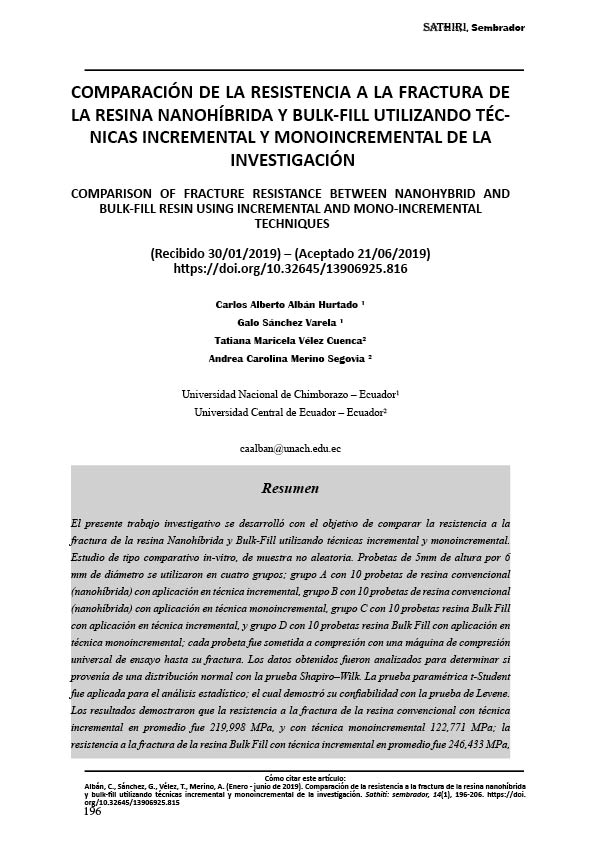
This research aimed to compare the fracture resistance between nanohybrid and Bulk-Fill resin using incremental and mono-incremental techniques. This is a comparative study in-vitro, non- random sample. Probes 5 mm high by 6 mm in diameter are used in four groups; group A with 10 specimens of conventional resin (nanohybrid) with application in the incremental technique, group B with 10 specimens of conventional resin (nanohybrid) with the application in the mono-basic technique, group C with 10 specimens of resin Bulk Fill with the application in the incremental technique, and group D with 10 Bulk Fill resin specimens with application in mono-basic technique; Each time a compression was tested with a universal test compression machine until its fracture. Data were analyzed to determine if a normal distribution with the Shapiro-Wilk test. The t-Student parametric test was applied for the statistical analysis; Which proved its reliability with the Levene test. The results showed that the fracture resistance of conventional resin with incremental technique on average was 219,998 MPa, and with mono-basic technique 122,771 MPa; The fracture resistance of Bulk Fill resin with incremental technique on average was 246.433 MPa, and with mono-basic technique 251.322 MPa. It is concluded that there is a significant difference between the fracture resistance of conventional resin (nanohybrid) and Bulk Fill resin with incremental and mono- incremental techniques.Downloads
Download data is not yet available.
Downloads
Published
2019-06-30
Issue
Section
CIENCIAS DE LA SALUD
License
Copyright (c) 2019 Carlos Alberto Albán Hurtado, Galo Sánchez Varela, Tatiana Maricela Vélez Cuenca, Andrea Carolina Merino Segovia

This work is licensed under a Creative Commons Attribution-NonCommercial-NoDerivatives 4.0 International License.
El autor mantiene los derechos morales e intelectuales de su obra, autorizando a la editorial de la revista Sathiri la difusión y divulgación de su contenido con fines estrictamente académicos y de investigación, sin fines de lucro. Así mismo, se autoriza que la obra sea descargada y compartida con otras personas, siempre y cuando no sea alterada y se reconozca su autoria.
How to Cite
Albán Hurtado, C. A., Sánchez Varela, G., Vélez Cuenca, T. M., & Merino Segovia, A. C. (2019). Comparison of fracture resistance between nanohybrid and bulk-fill resin using incremental and mono-incremental Techniques. SATHIRI, 14(1), 196-206. https://doi.org/10.32645/13906925.816