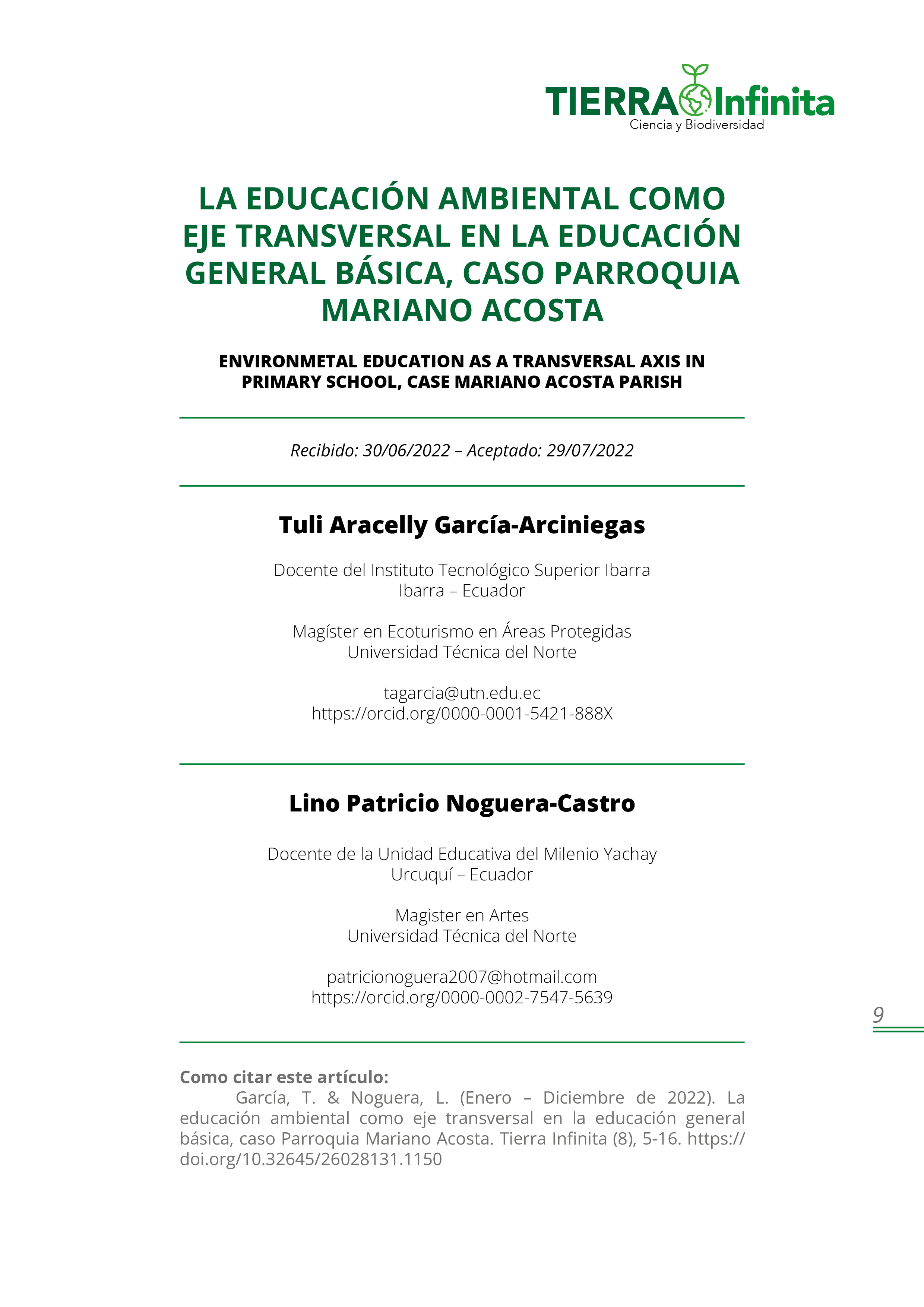
Environmetal education as a transversal axis in primary shool , case Mariano Acosta Parish
DOI:
https://doi.org/10.32645/26028131.1150Keywords:
curriculum, environmental education, general basic education, transversalAbstract
The Ecuadorean Educative System, supported in the human development, propends to deploy resources that favor educating fair, innovative, critical, caring individuals, committed with the sustainable development of the country; In this context, the General Basic Education National Curriculum opens the possibility of including transversal topics that promote the integrality beyond the disciplinary dimension at this level of education, which realization is the profile of graduation. Currently, there are concerns about the little evidence of initiatives to address the environmental dimension, which in this proposal erects as a fundamental component head to head to education process through knowledge and comprehension practices related to environmental education. This study had as objective to propose a study training plan in environmental education from the transversal curricular view supported in the flexibility of the meso curriculum, promoting the consideration of the environmental dimension not only as contents but as process in all the knowledge domains. This was a qualitative study with a bibliographic and field design. The techniques were: survey, interview, direct observation in the schools of Mariano Acosta Parish, Pimampiro. In conclusion, the finding was that the children lack of theoretical and practical knowledge in environmental education, unveiling the absence of wisdom in the topic which restricts deploying values, commitments and responsible attitudes in favor of the environment. The transversal development of the environmental education must be constructed in an articulator axis of the curricular structure.
Downloads
References
- Alvira, M. (2011). La encuesta: una perspectiva general metodológica (2nd. ed.). CIS - Centro de Investigaciones Sociológicas. ProQuest Ebook .
- Asamblea Nacional del Ecuador. (2008). Constitución de la República.
- Asamblea Nacional del Ecuador. (2011). Ley Orgánica de Educación Intercultural.
- Barrios Fernández, L. A. (2018). La educación ambiental en el contexto escolar. La Habana, D - Universidad de Ciencias Pedagógicas "Enrique José Varona". https://elibro.net/es/ereader/utnorte/106340?page=10.
- López, S, y Martín, S. (2013). Programas de educación ambiental. Madrid, ES: Editorial CEP, S.L. ProQuest ebrary.
- Ministerio de educación del Ecuador. www.educación.gob.ec.2017.
- Naciones Unidas. (2018). La Agenda 2030 y los Objetivos de Desarrollo Sostenible: una oportunidad para América Latina y el Caribe (LC/G.2681-P/Rev.3), Santiago.
- Palladino, E. (2005). Proyecto y contenidos transversales. Buenos Aires, Argentina: Espacio Editorial. https://elibro.net/es/ereader/utnorte/66889?page=11.
- Sánchez Fontalvo, I. M. González Monroy, L. A. y Esmeral Ariza, S. J. (2020). Metodologías cualitativas en la investigación educativa. Santa Marta, Colombia, Editorial Unimagdalena. Recuperado de:https://elibro.net/es/ereader/utnorte/170301?page=24.
- Trujillo, C., Naranjo, M. Lomas, K. y Merlo, M. (2019). Investigación Cualitativa. Editorial Universidad Técnica del Norte UTN. Red de Ciencia Naturaleza y Turismo RECINATUR, Valdivia Chile.
- Vidal, N. (2004). La problemática global del agua, El Cid Editor. ProQuest Ebook Central, http://ebookcentral.proquest.com
Downloads
Published
Issue
Section
License
Copyright (c) 2022 Tuli Aracelly Garcia Arciniegas, Lino Patricio Nogera Castro

This work is licensed under a Creative Commons Attribution-NonCommercial-NoDerivatives 4.0 International License.
El autor mantiene los derechos intelectuales y morales de su obra, autorizando a la editorial de la Revista Tierra Infinita la difusión y divulgación de su contenido con fines estrictamente académicos y de investigación, sin fines de lucro.