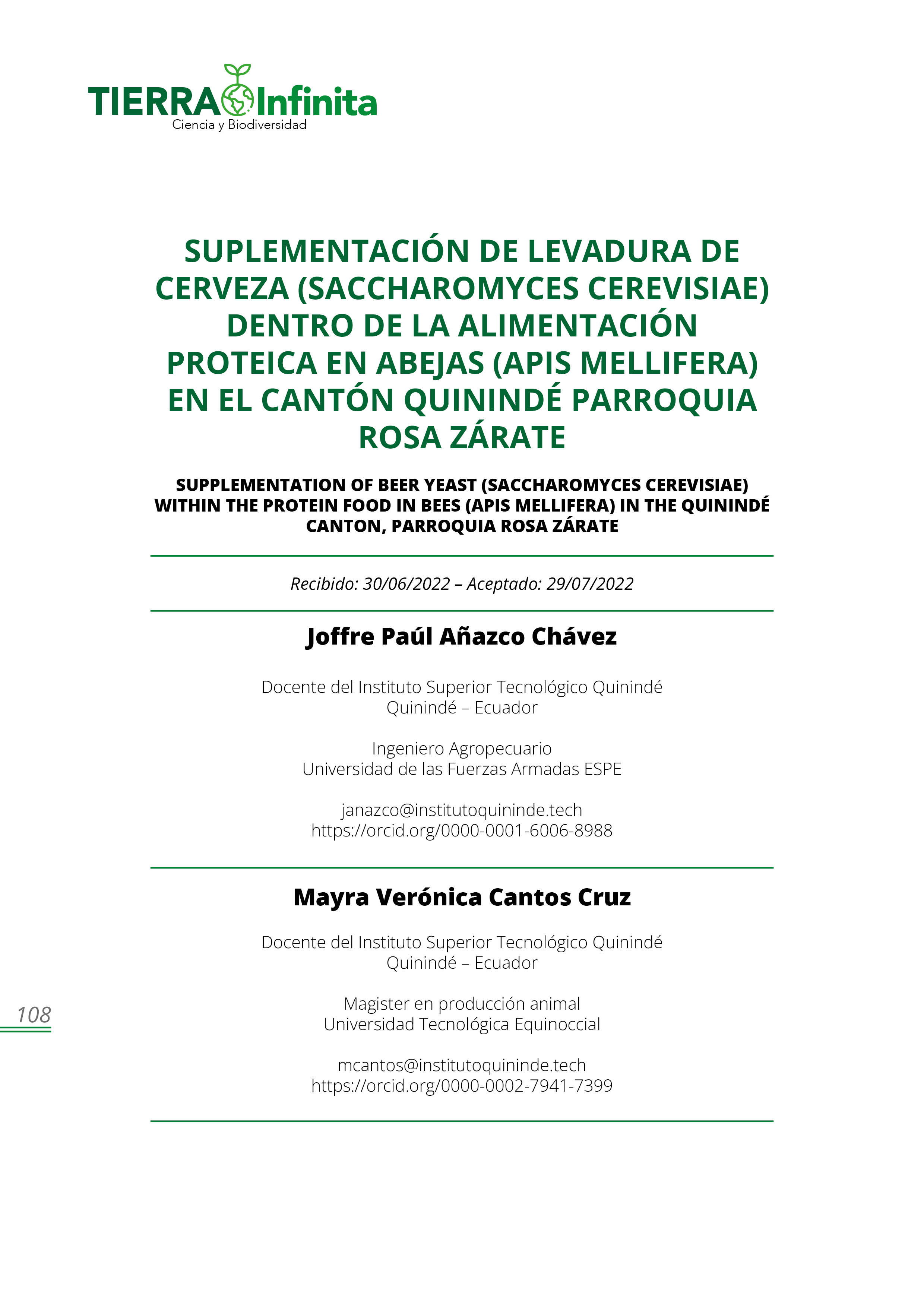
Supplementatio of beer yeast (Saccharomyes cerevisiae) within the protein food in bees (Apis Mellifera) in the Quinindé canton, parroquia Rosa Zarate
DOI:
https://doi.org/10.32645/26028131.1156Keywords:
protein supplement, beekeeping, beesAbstract
Bees are insects that are very important in the natural chain for food production, having the limitation that in winter times or during the establishment of the hive, there is a precarious or null amount of nutrients necessary for their individual and population maintenance, proportionally decreasing the general production of the apiary, being necessary to determine the acceptability of artificial protein supplements in newly established hives as an aid to their adaptability and weight gain of the apiary. In this research, an analysis of the acceptability and influence of protein supplementation of artificial origin on the number, weight and production of the members of the hive is carried out. The experiment was carried out in the dry season, six hives were used with a capture time between 1 - 15 days before the start of the investigation. The trial-error technique was used in order to determine the acceptability of an artificial protein supplement that allows improving the vigor of the hive and whose data obtained were quantified to determine the results.
The protein cake was composed of lentil flour, corn flour and brewer’s yeast with 20% protein. The results showed acceptability of the artificial protein supplement that allowed to achieve a higher average weight of the production and numerical increase of the members of the hive, so the use of these supplements becomes essential in times of food scarcity.
Downloads
References
- ApiExpert Staff. (2016). ApiExpert. La alimentación proteica suplementaria de la abeja. España. Copyright. Recuperado de http://apiexpert.eu/es/alimentacion-proteica-suplementaria-abeja/
- Avilez, J. P., & Araneda, X. (2007). Estimulacion de la puesta en abejas (Apis mellifera). Archivos de zootecnia, 56(216), 885-893.
- Bayer Bee Care Center (2018). La Importancia de los insectos polinizadores en la agricultura. BEEINFOrmed N° 7.
- Carvajal, V. (2020). Importancia de las abejas como polinizadores.
- Castro, M., & de Souza Rodriguez, F. (2005). Levaduras: probióticos y prebióticos que mejoran la producción animal. Ciencia y Tecnología Agropecuaria, 6(1), 26-38.
- Cervantes Grijalva, E. R. (2010). Incidencia de la alimentación suplementaria en la producción y productividad de la apicultura, Colimbuela-Cotacachi (Bachelor's thesis).
- Córdova Muicela, V. E. (2017). Evaluación de fuentes proteicas en la alimentación de las abejas (Apis mellifera) (Bachelor's thesis).
- DeGrandi-Hoffman, G., Wardell, G., Ahumada-Segura, F., Rinderer, T., Danka, R., & Pettis, J. (2008). Comparisons of pollen substitute diets for honey bees: consumption rates by colo-nies and effects on brood and adult populations. Journal of apicultural research, 47(4), 265-270.
- Erickson Jr, E. H., & Sheng, H. (1984). Structure of the honeybee tentorium. Journal of Apicultural Research, 23(4), 181-188.
- Ghazala, N. E., & EE, N. (2013). Effect of Brewer’s yeast and soya bean cake on brood rearing, pollen gathering and honey yield in honey bee colonies. Annals of Agric. Sci., moshtohor, 51(3), 285-292.
- Lehner, Y. (1983). Nutritional considerations in choosing protein and carbohydrate sources for use in pollen substitutes for honeybees. Journal of Apicultural Research, 22(4), 242-248.
- Medina Flores, C. A., Guzmán Novoa, E., Saldívar Frausto, S., & Aguilera Soto, J. (2018). Effect of three energy-protein diets on honey bee population and honey production of Apis mellif-era colonies. Nova scientia, 10(20), 1-12.
- Molina Reyes, A. O. (2010). Tipificación de los sistemas de producción apícola de siete municipios del departamento de Huehuetenango (Doctoral dissertation, Universidad de San Carlos de Guatemala).
- Montero, A., Martos, A., & Chura, J. (2012, June). Dietas artificiales en la crianza de la Abeja Melífe-ra, Apis mellifera L. In Anales Científicos (Vol. 73, No. 1, pp. 1-5).
- Muniategui, S., Simal, J., Huidobro, J. F., & García, M. C. (1989). Estudio de los ácidos grasos del polen apícola. Grasas y Aceites, 40(2), 81-86.
- Núñez-Torres, O. P., Almeida-Secaira, R. I., Rosero-Peñaherrera, M. A., & Lozada-Salcedo, E. E. (2017). Fortalecimiento del rendimiento de abejas (Apis mellifera) alimentadas con fuentes proteicas. Journal of the Selva Andina Animal Science, 4(2), 95-103.
- Organización de las Naciones Unidas para la Alimentación y la Agricultura (FAO), (2018), Es hora de apreciar la labor de los - polinizadores. Seis formas de mostrar nuestra gratitud a las abejas, las mariposas y otros polinizadores imprescindibles.
- Piccalaico Hancco, J. (2019). Suministro de torta proteica como suplemento de polen con tres nive-les de proteína en el crecimiento poblacional de abejas-Centro Agronómico K’ayra.
- Rodríguez-Vera, G. G., Tucuch-Haas, C. J., Martínez-Puc, J. F., & Casanova-Lugo, F. (2015). Desa-rrollo Poblacional de Abejas (Apis mellifera L.) en Respuesta a la Dieta Alimenticia. AGROECOSISTEMAS TROPICALES, 455.
- Standifer, L. N. (1978). Supplemental feeding of honey bee colonies (No. 413). Department of Agriculture, Science and Education Administration.
- Younis, M. S. (2019). Evaluation of Ten Supplemental Diets to Enhance Some Honey Bee (Apis mellifera L.) Activities during Winter Season in Egypt. Egyptian Academic Journal of Biolog-ical Sciences. A, Entomology, 12(6), 101-109.
Downloads
Published
Issue
Section
License
Copyright (c) 2022 Joffre Paúl Añazco Chávez, Mayra Verónica Cantos Cruz, Eugenio David Plaza Cedeño, Johann Santiago Morales Moreira

This work is licensed under a Creative Commons Attribution-NonCommercial-NoDerivatives 4.0 International License.
El autor mantiene los derechos intelectuales y morales de su obra, autorizando a la editorial de la Revista Tierra Infinita la difusión y divulgación de su contenido con fines estrictamente académicos y de investigación, sin fines de lucro.